






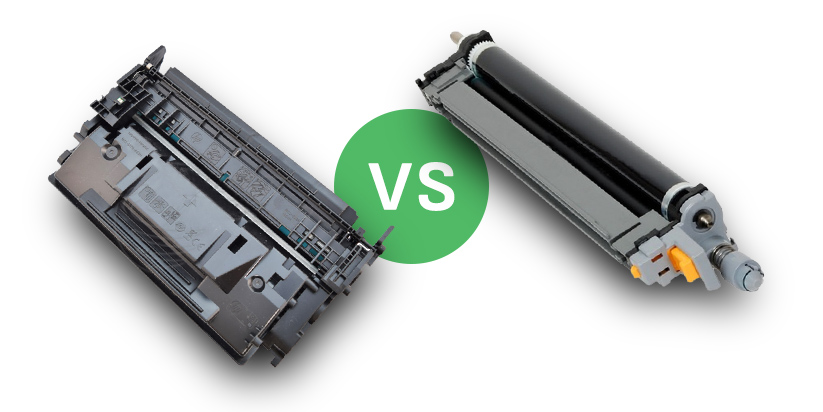
Many users believe that the toner cartridge and the drum unit are the same thing. This is not true. The toner cartridge contains the powdered toner, while the drum is the component that transfers the toner onto the paper through an electrostatic process. The difference is important because the two elements have different lifespans, maintenance requirements, and costs.
What Is a Toner Cartridge?
The toner cartridge is the consumable that contains powdered toner. This powder is used by laser printers and multifunction devices to create text and images on paper.
Here are its main characteristics:
-
Contains toner powder
A finely ground powder made of pigments and polymers that melts and fuses onto the paper at high temperatures. -
Has a limited capacity
The capacity is measured in number of pages at 5% coverage, according to the ISO/IEC 19752 standard for monochrome printers. -
Requires periodic replacement
When the toner runs out, print quality decreases – faded areas or a message indicating an empty consumable may appear. -
Can be original or compatible
Original cartridges are manufactured by the printer manufacturer, while compatible ones are produced by third parties according to certain technical specifications.
After the toner is depleted, it is not necessary to replace the entire printing mechanism, only the cartridge itself, unless the device is a model with an integrated drum.
What Is a Drum Unit?
The drum unit, also called a photosensitive cylinder or imaging drum, is the component that transfers the image onto the paper. It operates through an electrostatic process characteristic of laser technology.
The working process goes through several stages:
-
Charging the drum
Its surface receives an electrostatic charge. -
Laser exposure
The laser beam “draws” the image by changing the charge in specific areas. -
Attracting toner
The toner adheres only to the areas with the altered charge. -
Transfer onto paper
The image is transferred and fixed through heat.
The drum does not contain toner. It is a separate mechanical component and has a longer lifespan than the toner cartridge. In many models, its yield reaches tens of thousands of pages, depending on the manufacturer and operating conditions.
When Are the Toner and Drum Combined?
In some brands, such as certain HP and Canon models, the drum is integrated directly into the toner cartridge. This means that every time the toner is replaced, the drum itself is also automatically replaced, without the need to purchase a separate component.
In other manufacturers, such as Brother and certain OKI models, the design is different – the drum is a separate module. In these cases, the toner cartridge is replaced more frequently because it contains only the powdered toner, while the drum has a longer service life and is replaced much less often. This can lead to lower long-term costs.
This difference in construction is one of the most common reasons for confusion among users.
How Can You Tell Which Component Needs Replacement?
Before replacing any component, it is important to recognize the symptoms and connect them to the specific cause. Different defects point to different parts of the device.
Symptoms indicating toner cartridge replacement:
-
faded and uniformly weak print across the entire page;
-
“Replace Toner” or “Toner Low” message on the display;
-
gradual fading of text and images.
These signs indicate that the toner is depleted or nearing the end of its yield and the toner cartridge should be replaced.
Symptoms indicating drum replacement:
-
repeating vertical lines;
-
repeating spots or shadows at equal intervals on the page;
-
gray background or smudging appearing in the same places on every printout.
These defects usually indicate a worn or damaged drum and require its replacement.
Once you identify the symptom, check the manufacturer's manual or the official model website to determine whether the drum in your device is a separate module or integrated into the toner cartridge.
Which Part Has a Greater Impact on Print Quality?
Print quality depends on both components, but in different ways.
The toner determines the richness and density of the text. The drum affects the sharpness and uniformity of the image.
If you use low-quality toner, you may get faded prints, while a worn drum will cause repeating defects and lines.
That is why, when a problem occurs, it is important to identify the correct source instead of unnecessarily replacing both elements.
The difference between a toner cartridge and a drum is not just a technical detail. It directly affects maintenance costs, print quality, and proper diagnostics when problems occur. When you understand the function of each component, you will be able to make informed decisions and extend the life of your device.
Frequently Asked Questions
Can I damage the printer if I continue printing with a worn drum?
Yes, prolonged operation with a worn drum can lead to additional contamination of the internal components and deterioration in print quality. In the long term, this increases the risk of more serious damage and higher repair costs.
Is a device with a separate drum or an integrated drum more cost-effective?
That depends on the print volume. For higher monthly print volumes, a device with a separate drum is often more economical because the drum is replaced less frequently. For lower workloads, the difference in costs may be minimal.
Do storage conditions matter for the toner cartridge and drum?
Yes. Both components should be stored in a dry place, at a moderate temperature, and away from direct sunlight.