





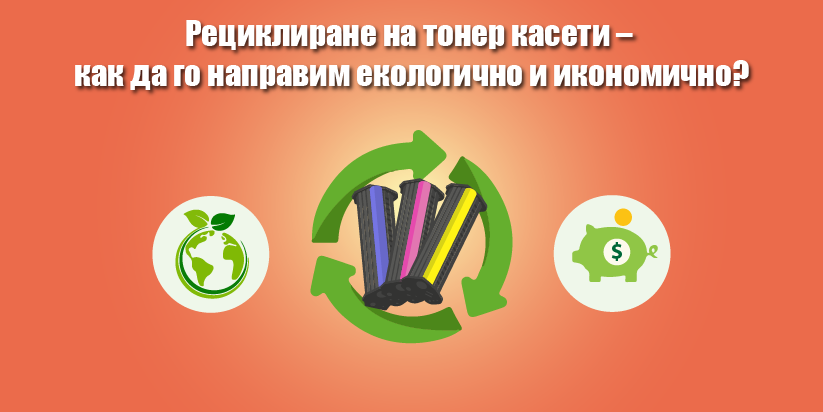
Recycling toner cartridges is no longer just an “eco initiative”, but a practical necessity for every office and home with a laser printer. This process reduces waste, limits environmental impact, and, not least, leads to significant financial savings.
In Bulgaria, the network of companies and service centers for collecting, refilling, and recycling is well-developed and operates according to high standards. But what do you actually gain, and how do you choose a reliable partner?
Why is recycling truly important?
Responsible handling of printer consumables is part of the so-called circular economy. More and more clients and partners require this as part of corporate ESG (environmental, social, and governance) policies.
Environmental impact
A toner cartridge is a complex product composed of:
-
high-quality, long-lasting plastic;
-
metal components - aluminum and other metals;
-
residual toner - fine powder particles;
-
rubber and elastomer components.
When such a consumable ends up in general household waste and is landfilled:
-
the plastic takes hundreds of years to decompose;
-
toner contains fine particles that, if improperly handled, may pollute the air, soil, and water;
-
illegal burning releases harmful gases.
Globally, scientific studies show that only about 20-30% of waste toner and related consumables are recycled; the rest ends up in landfills or is incinerated.
This means that every cartridge you send for recycling truly makes a difference.
Major manufacturers like HP report that within the HP Planet Partners program, about 90% of materials from returned original toner cartridges are recycled and used in new products, and 0% end up in landfills.
This is a clear example of how a consumable can re-enter the “closed loop” instead of ending up as waste.
Circular economy: waste as a resource
Laser printer cartridges are a typical example of a product suitable for a circular economy. Their journey after first use usually goes through three stages:
-
Re-use of the housing and mechanics
The housing and many mechanical components can be reused multiple times after inspection and replacement of worn parts. This extends product life and reduces the need for new manufacturing. -
Refilling
The toner and certain components are replaced (e.g., drum, rollers, chips) when necessary. This preserves print quality with minimal resource footprint. -
Material recycling at end-of-life
When the housing is no longer usable, the cartridge is disassembled, and materials are sorted by type - plastic, metal, residual toner, packaging materials. Bulgarian companies like Ecologica state that these materials are forwarded to appropriate recycling streams.
Legal requirements
In Bulgaria, waste from printer consumables falls under the Waste Management Act (WMA) and related regulations. The law emphasizes:
-
prevention and reduction of waste generation;
-
encouraging reuse, recycling, and recovery;
-
extended producer responsibility for products that become hazardous or mass-distributed waste after use.
Practical implications for users:
-
for businesses: companies must hand over their waste to licensed operators. This helps with audits, ISO compliance, and avoiding fines. Always request a handover protocol.
-
for individuals: disposing of cartridges in general household waste is prohibited. Stores and municipalities increasingly provide collection points.
How to recycle properly? (Practical guide)
Eco-friendly handling requires no effort - only good habits.
Steps for the user
-
Do not throw them in the trash: collect empty cartridges in a separate box or in their original packaging.
-
Do not disassemble: never break or open the cartridge. This releases harmful toner dust and makes the cartridge unusable for reuse.
-
Find a collection point:
-
specialized refill and printer service centers (most common);
-
office-tech stores with buy-back programs;
-
e-waste collection points.
-
-
Hand them over responsibly: if you are a business, request an official document.
The role of service centers
Specialized service centers are the “heart” of this process. They don’t just collect waste - they professionally restore cartridges. They diagnose which cartridges can be safely refilled and which must be sent for shredding. This guarantees print quality comparable to the original but at a much lower cost.
How to choose a reliable service center?
Not all service centers offer the same quality. To be satisfied with the result:
-
Look for specialization - avoid places that refill cartridges “on the side”.
-
Ask for a warranty - a good service center guarantees page yield and print quality.
-
Traceability - ask whether they replace chips and drums, or only add toner.
-
Documentation - ensure they can issue a protocol for unusable cartridges handed over.
You can explore the service provided by TonerStream in detail here - Toner Cartridge Streaming
Frequently Asked Questions (FAQ)
-
Where can I return old toner cartridges?
Go to specialized printer service centers, refill companies (such as Toner Stream), or tech stores with e-waste bins.
-
Can every cartridge be recycled?
Almost all original cartridges (HP, Canon, Brother, Samsung) can be refilled or recycled. Broken or heavily deformed housings can only be material-recycled (plastic and metal).
-
Is the toner dangerous?
Toner is a fine powder that should not be inhaled. Under normal use the cartridge is safe, but when broken or disassembled at home, it poses risks. Always hand over intact cartridges.
-
How many times can a cartridge be refilled?
It depends on the model and housing condition. Typically, an original cartridge can withstand 2 to 4 professional recycling cycles (with parts replaced) before the plastic wears out and must be scrapped.